
The dark web is one of the most misunderstood parts of the internet. It is often associated with anonymous communication, stash patrick cybercrime, stolen information, and underground marketplaces. While some dark-web technologies can have legitimate privacy-related uses, criminal groups have also used anonymous networks to facilitate illegal activities.
The name Stash Patrick may appear in discussions surrounding underground marketplaces and stolen financial information. stashpatrick.cc For beginners, understanding such references is best approached from a cybersecurity and digital-safety perspective. The goal should be to understand the risks associated with these environments without participating in illegal activity.
This guide explains what dark-web marketplaces are, why they exist, how they create security risks, and what individuals and organizations can do to protect themselves.
What Is the Dark Web?
The internet is often described as having several layers.
The surface web consists of websites that search engines can normally discover and index. News websites, public company pages, blogs, and online stores are examples.
The deep web contains information that is not generally indexed by search engines. Private email accounts, online banking portals, subscription databases, and company systems are examples of deep-web content.
The dark web is a smaller part of the internet that is intentionally designed to provide additional anonymity and requires specialized technologies to access. While anonymity can serve legitimate purposes, criminals can also use it to conceal illegal activities.
It is important to remember that the dark web itself is not synonymous with crime. The technology has legitimate applications, but certain hidden services have become associated with illegal marketplaces and cybercrime.
What Are Dark-Web Marketplaces?
Dark-web marketplaces are online platforms that operate through anonymous networks and may facilitate the exchange of goods or services.
Some marketplaces have historically been associated with illegal products, stolen information, counterfeit documents, malicious software, or other prohibited materials.
These platforms may resemble ordinary online marketplaces in appearance. They can have listings, user accounts, reputation systems, and communication features. However, their underlying activities can be criminal and dangerous.
For beginners, this similarity can be misleading. A professional-looking interface does not make a marketplace legitimate or trustworthy.
Understanding the Stash Patrick Reference
Stash Patrick may be mentioned in online discussions about underground carding environments or markets involving compromised payment information.
Rather than treating the name as a conventional financial service, it is more useful to understand it as part of the broader conversation about stolen financial data and cybercrime.
Underground markets can involve multiple participants. One group may obtain information through phishing, malware, or data breaches, while others attempt to distribute or monetize it.
This specialization can create a broader criminal economy in which different participants perform different tasks.
Understanding this structure helps cybersecurity professionals identify how attacks can progress from initial data theft to attempted financial exploitation.
How Stolen Financial Information Is Obtained
Payment information can be compromised through several common attack methods.
Phishing is one of the most widespread. Criminals may send fraudulent emails, messages, or websites designed to imitate trusted companies. Victims may be persuaded to provide passwords, card information, or authentication codes.
Data breaches are another source of exposure. If attackers compromise a company’s systems, customer information may be stolen.
Malware can also capture sensitive information from infected devices. Some malicious programs are designed to steal credentials, browser information, or other valuable data.
Social engineering is another important technique. Instead of exploiting a software vulnerability, criminals may manipulate individuals into revealing information or approving transactions.
These methods show why cybersecurity requires both technical defenses and user awareness.
Why Dark-Web Marketplaces Are Dangerous
People who investigate underground marketplaces may face risks even when they have no intention of committing a crime.
Illicit websites can contain malicious advertisements, phishing pages, fraudulent downloads, or malware. Visitors may also encounter scams designed to steal money or personal information.
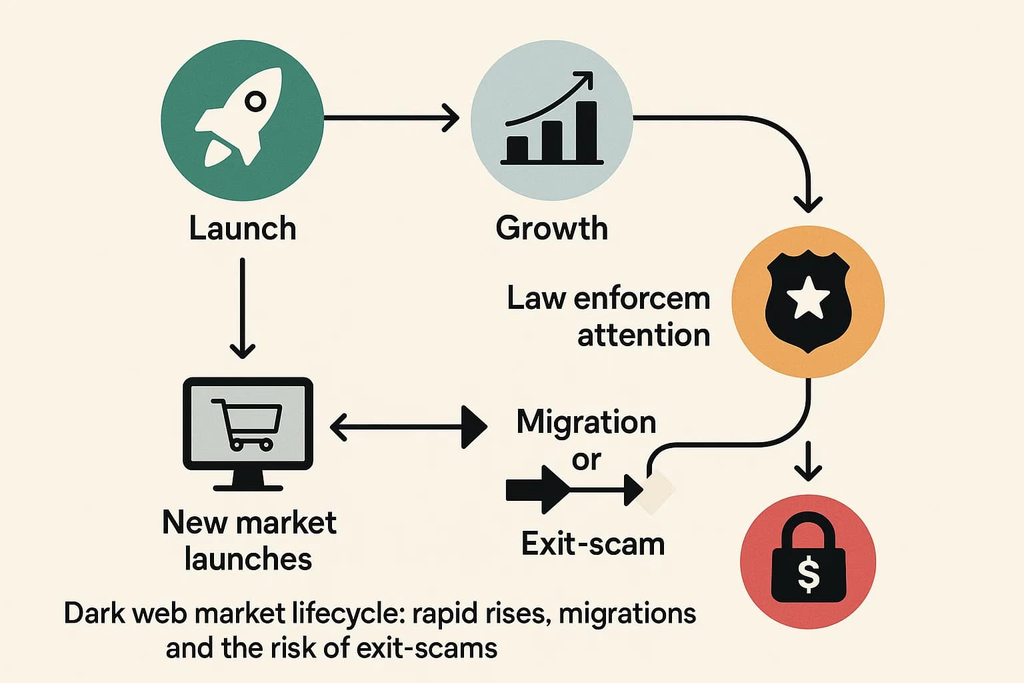
Criminal marketplaces can be unstable as well. Operators may disappear, platforms may be attacked, and law-enforcement investigations can result in sudden shutdowns.
There is also a legal risk associated with purchasing or possessing stolen information.
For these reasons, beginners should avoid direct interaction with illicit marketplaces and instead learn through reputable cybersecurity resources, academic research, and published investigations.
The Role of Anonymity
Anonymity is a central feature of many dark-web technologies.
Privacy systems can make it more difficult to determine who operates a website or who is communicating with whom. This can be beneficial for legitimate users who need privacy, but it can also create opportunities for criminal activity.
Anonymity does not guarantee safety. Users may still be exposed through scams, malware, operational mistakes, compromised accounts, or other technical weaknesses.
A common misconception is that using anonymous technology makes someone completely untraceable. In reality, investigations can involve multiple sources of evidence, including financial records, infrastructure information, account activity, and mistakes made by participants.
Protecting Yourself From Stolen Data
The best defense against underground financial markets is preventing personal information from becoming compromised.
Consumers should use strong and unique passwords for important accounts. Password managers can make this easier.
Multi-factor authentication should be enabled whenever possible, particularly for email, banking, and financial accounts.
Users should also keep operating systems, browsers, and applications updated. Security patches can address vulnerabilities that attackers might otherwise exploit.
Transaction alerts are another valuable tool. Notifications can help users identify unauthorized purchases quickly.
People should also be careful with unexpected messages requesting passwords, payment information, or verification codes.
What Businesses Can Do
Businesses face significant risks because they often store large quantities of customer information.
Organizations should collect only the information they genuinely need and protect sensitive data using appropriate security controls.
Encryption, access restrictions, network monitoring, vulnerability management, and employee training can reduce exposure.
Businesses should also have an incident-response plan. If a breach occurs, organizations need procedures for containing the incident, investigating the cause, notifying affected parties when required, and improving security afterward.
Payment tokenization can also reduce the exposure of actual card credentials during transactions.
How Researchers Study Dark-Web Markets
Cybersecurity researchers may study underground marketplaces to understand emerging threats. However, responsible research does not require purchasing stolen information.
Researchers can examine public reports, security-company research, court records, law-enforcement announcements, academic publications, and other legitimate sources.
This approach can provide valuable insight into criminal trends while reducing the risks associated with direct interaction.
Researchers should also be careful when handling potentially sensitive information and follow appropriate ethical and legal guidelines.
Why These Markets Keep Changing
Dark-web marketplaces are rarely permanent. Platforms can disappear because of technical problems, internal disputes, scams, arrests, or law-enforcement operations.
When one platform disappears, criminal participants may attempt to move elsewhere.
This means cybersecurity professionals cannot rely on eliminating one website as a permanent solution. The broader objective is to reduce the ability of criminals to steal information and profit from it.
Better authentication, fraud detection, data protection, and consumer awareness can make stolen information less useful.
The Future of Dark-Web Security
As digital payments and online accounts become increasingly important, protecting personal information will remain a major cybersecurity priority.
Financial institutions are investing in behavioral monitoring, artificial intelligence, tokenization, biometric authentication, and real-time fraud detection.
Consumers are also becoming more aware of phishing and account-takeover threats.
At the same time, criminals continue to adapt. Social engineering, malware, credential theft, and other techniques can evolve as defensive technologies improve.
The result is an ongoing security cycle in which organizations must continually improve their defenses.
Conclusion
A beginner’s understanding of Stash Patrick and dark-web marketplaces should begin with cybersecurity awareness rather than curiosity about participating in underground activity.
Dark-web technologies can have legitimate privacy applications, but certain marketplaces have been associated with serious criminal activity, including the distribution of stolen financial information. Names such as Stash Patrick can therefore be understood within the broader context of underground payment-card markets and financial cybercrime.
Consumers can reduce their risk by using unique passwords, enabling multi-factor authentication, monitoring financial accounts, keeping software updated, and avoiding suspicious messages.
Businesses can strengthen defenses through encryption, tokenization, access controls, security monitoring, employee training, and effective incident-response planning.
Ultimately, learning about dark-web marketplaces is most valuable when that knowledge is used for prevention. Understanding how stolen information can move through criminal ecosystems helps individuals, businesses, and cybersecurity professionals build stronger defenses against financial fraud and other online threats.